About MPRI
Established in 2017 under Canada’s Oceans Protection Plan and renewed in 2022, Canada’s Multi-Partner Research Initiative (MPRI) brings together international researchers and knowledge holders to advance research and technology innovation in support of evidence-based decision making for improved oil (and alternative fuel) spill response.
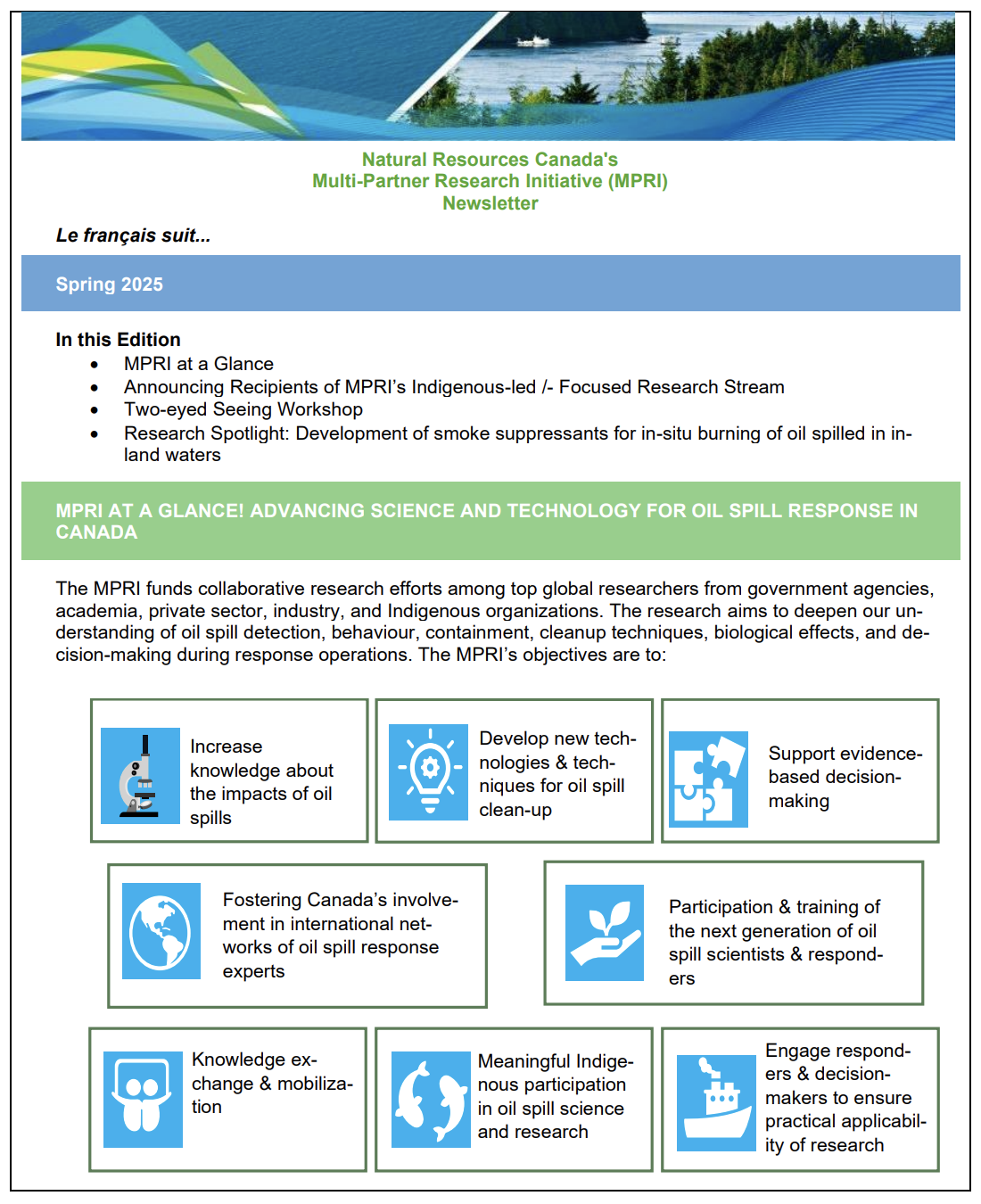
Currently led by Natural Resources Canada, the MPRI’s main objectives are to:
- Improve available tools, techniques and technologies in spill response
- Foster Canada’s involvement in international networks of oil spill response experts
- Foster meaningful Indigenous participation in oil spill research
- Mobilize knowledge
- Train the next generation of oil spill responders
During Phase 1 (2017–2022), MPRI was led by Fisheries and Oceans Canada and provided over $50 million to 40 research projects focused on ship-sourced oil spills in marine environments. See DFO’s MPRI.
Phase 1 culminated in the highly successful IOSSC 2022 (Oct 4–7, 2022, Halifax; virtual Oct 13–14), bringing together 250+ in-person and 150+ virtual participants worldwide to share advances in spill prevention, response planning, remediation, recovery, and policy.
Now under Natural Resources Canada, Phase 2 expands to include spills of both conventional and alternative fuels in freshwater, coastal, and marine environments from land and marine-based sources (including pipelines and offshore platforms), and supports the integration of Indigenous knowledge and perspectives.
NRCan’s MPRI has invested over $20.3M in 27 projects across Canada, involving ~300 researchers from 90 institutions and 6 countries, including 7 Indigenous-led projects that bridge Western science and Indigenous methodologies to address Nations’ priorities. See NRCan’s MPRI.
Building on the success of IOSSC 2022, MPRI is proud to support IOSSC 2026, showcasing new knowledge and innovations generated under the Initiative and beyond, and strengthening national and international partnerships.